Reflection tools.

Tools for looking more closely at what you were thinking, feeling and experiencing before a trading decision.

The Emotion Wheel

A way to describe what you are feeling with greater precision.
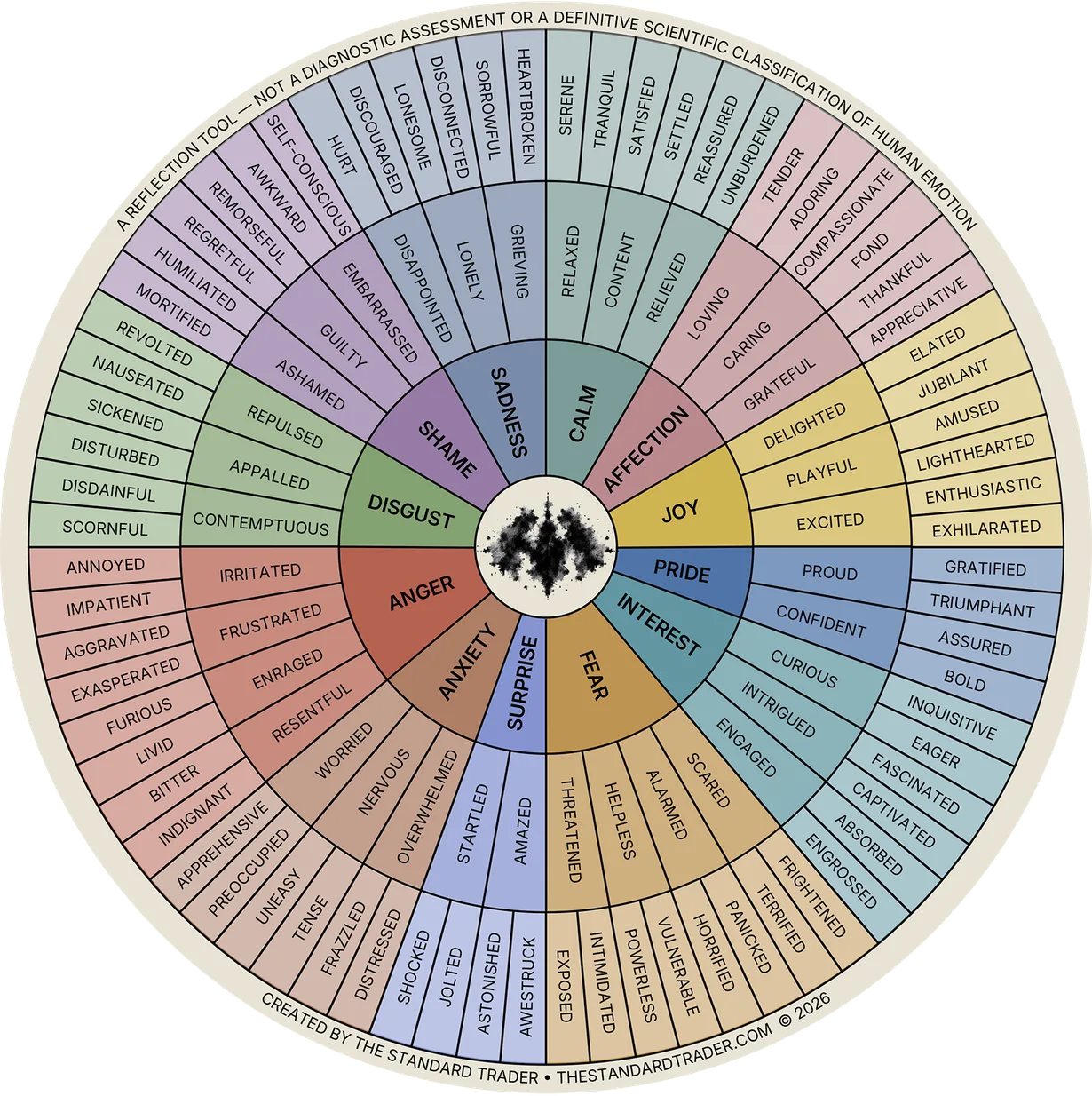
The Standard Trader emotion wheel: broad emotional families at the center, with progressively more specific descriptions on each outer ring.

Using the Emotion Wheel

The purpose of the wheel is simple: to help you describe what you are feeling with greater precision.

Start near the center with the broad emotional family that feels closest to your current experience. Then move outward through that section to see whether one of the more specific descriptions fits better.

The rings represent increasing specificity, not necessarily increasing intensity. An emotion on the outer ring is not automatically “stronger” than the emotion beneath it — it is simply a more precise description.

You also do not need to choose only one emotion. Multiple may be present at the same time.

The value of the exercise is not finding a perfectly correct label. It is moving from something broad — such as ANGER or ANXIETY — toward a clearer understanding of what you are actually experiencing.

If a word on the wheel is unfamiliar, look it up in a dictionary before choosing it — a precise label only helps if you actually know what it means.

Download a printable version (PDF) ↓ Two US Letter pages: one color and one black-and-white.
From Body State to Behavior

A way to look beneath an action and consider what may be shaping it.

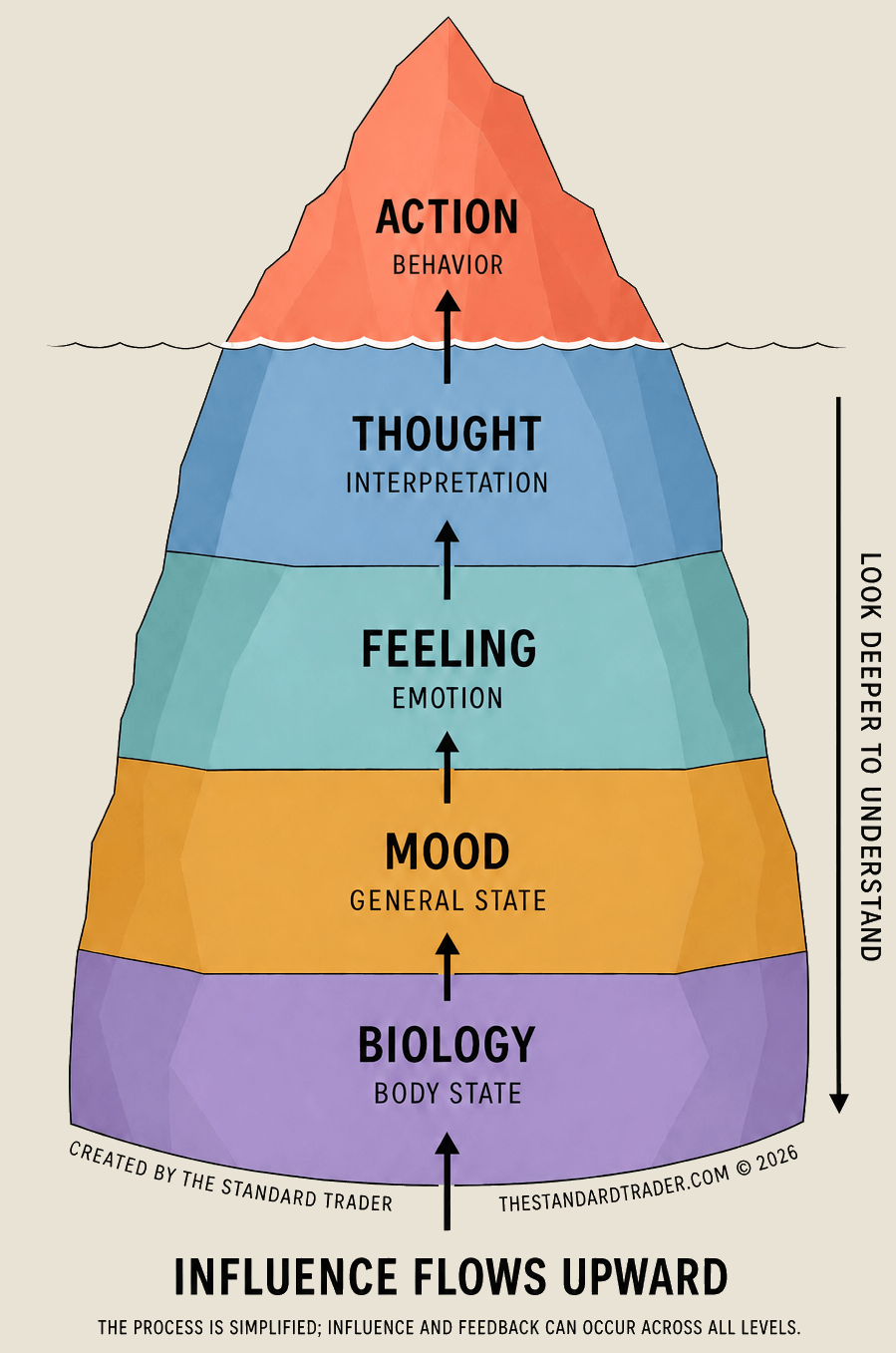
The iceberg model showing how biology and body state can influence mood, feeling, thought and action, while feedback can occur across all levels.

Using the Body State to Behavior Model

This model asks you to look beneath an action instead of treating behavior as though it appeared from nowhere.

Start at the top with what happened: the action or behavior. Then work downward. What were you thinking? What were you feeling? What was your broader mood or general state? And what was happening in your body?

The layers represent different levels of influence. Biology and body state—including sleep, fatigue, hunger, stress, pain or illness—can shape mood. Mood can make certain emotions more likely. Emotion can influence how we interpret events, and those interpretations can affect what we do.

The direction is not absolute. An action can change a thought, a thought can change a feeling, and feedback can occur between any of the levels. The diagram shows one useful progression, not a complete scientific account or a claim that any one layer wholly determines the next.

In trading, this can help separate the visible decision from the conditions that preceded it. Hesitation, impulsivity, overtrading or abandoning a plan may be easier to understand when you also examine the thoughts, feelings, mood and body state present at the time.

The point is not to excuse the action or find a single hidden cause. It is to understand the conditions that made that action more likely, so that you have more places to intervene next time.

Trading in the Zone

A book on trading psychology worth reading.

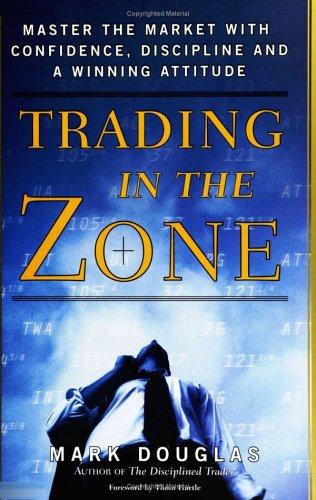
Cover of Trading in the Zone by Mark Douglas.

Mark Douglas's Trading in the Zone is about the mindset behind consistent execution — thinking in probabilities, and treating each trade as one instance in a larger sample rather than a single verdict on whether you were right. If the sessions or the tools on this site resonate with you, this book covers similar ground in more depth.

View on Amazon → Trading in the Zone, by Mark Douglas. Affiliate link: I may earn a commission at no additional cost to you.